
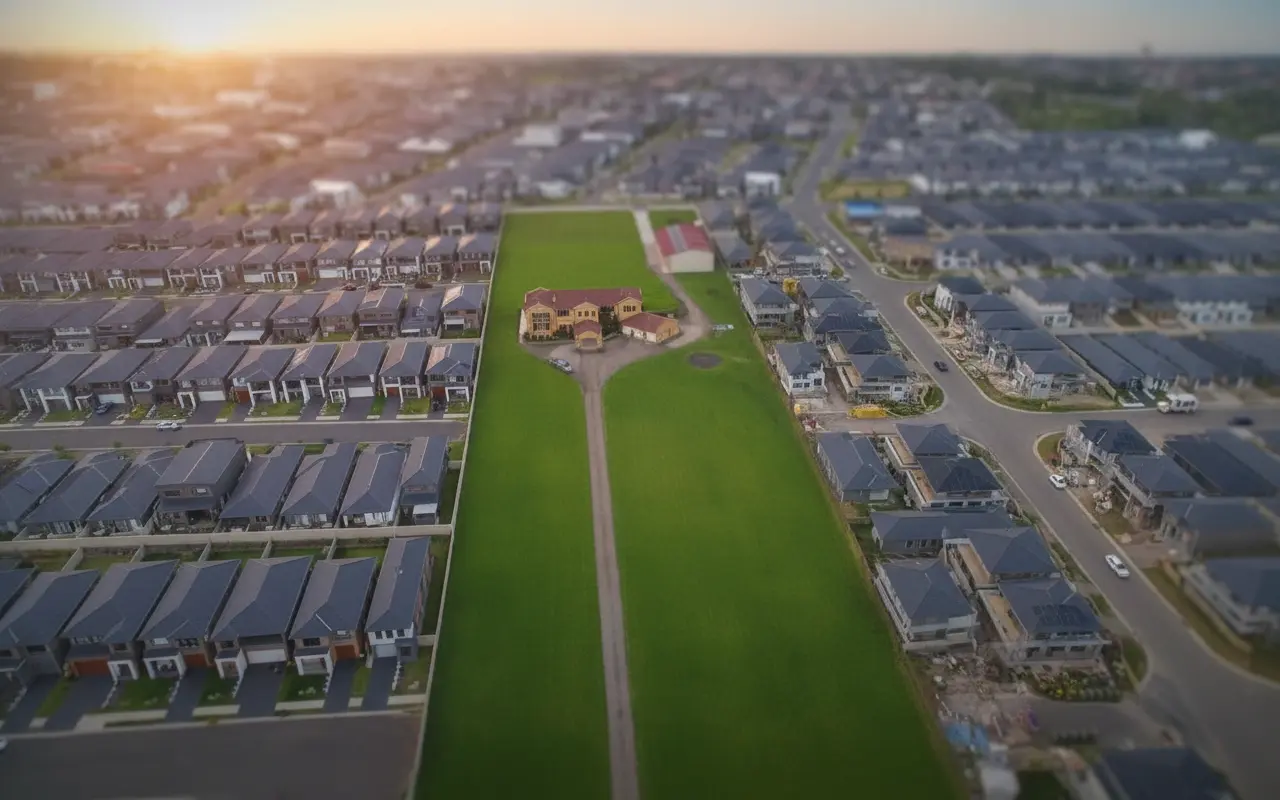
Picture yourself moving through a sea of identical gray rooftops, every house a clone of its neighbor—until, suddenly, one unique, brown-roofed property rises out of a vibrant green expanse like an oasis in suburbia. Welcome to Quakers Hill, about 40 kilometers west of Sydney, Australia, where the Zammit family’s home refuses to bow to the relentless tide of urban sprawl.
One House Against Uniformity
In a neighborhood dominated by monotonous suburban development, the Zammit residence stands out—literally. While homes fan out as far as the eye can see in orderly, gray-roofed uniformity, a large patch of green interrupts the pattern. And right in the middle of this green, the Zammits’ house, with its distinctive brown roof, catches every eye. An area resident, interviewed by 7 News Australia, couldn’t help but comment, “It looks like a castle!” Compared to its copy-paste-clone neighbors, it might as well be Camelot.
A Refusal Worth Millions
The Zammit family’s property sprawls across a massive 20,000 square meters of land. But this isn’t just a matter of space—it’s a story of unwavering resolve. Despite steadily growing pressure, the family has always refused to sell. Less than a decade ago, their one-of-a-kind home could be found listed on the market for 850,000 Australian dollars (just over 520,000 euros). Now, according to The Daily Mail, it could command up to 40 million dollars (around 25 million euros). You’d need a very large piggy bank to even consider bidding.
Yet, for the Zammits, it’s not just about the money. It’s about heritage, memory, and maybe a sprinkle of stubbornness in the face of bulldozers and blueprints.
The Price of Nostalgia
The neighborhood wasn’t always a patchwork of pressed-together homes. Diane Zammit, the matriarch, shared with the Australian Daily Mail a sense of loss for “the farmland, dotted with small houses and red brick cottages” they once enjoyed. Since they moved in over fifteen years ago, the area around their house has morphed beyond recognition.
Time-lapse drone videos posted on social network X (once known as Twitter, in case you blinked and missed it) illustrate this transformation. Once-vast fields around the Zammit property have rapidly been cut up, paved over, and built upon. The march of concrete, roads, and houses has left only one thing untouched: their own home—a stubborn monument to a disappearing past among growing urbanism.
Holding the Line: Fences, Roads and Neighbors
Not ready to watch their world shrink further, the Zammits put up 750 meters of fencing to protect what’s theirs and slow down development. The result? A unique impasse—literally. Because of their now-untouchable plot, new streets can’t run continuously through the development. On either side of the Zammit land, roads simply don’t meet up. Local urbanists may quietly gnash their teeth, but at least the kids can play outside in relative safety.
- A neighbor told 7 News Australia, “I’m very happy they refused to sell. It means we have a cul-de-sac, which is much safer for our kids—and that big lawn by our house makes it feel so spacious.”
For now, the status quo is here to stay: the Zammits are not planning to sell their iconic property. Taylor Bredin, a real estate agent interviewed by television and quoted in Business Insider, estimates the land could hold 50 houses of 300 square meters each—and that every one of them would fetch around a million Australian dollars (over 600,000 euros apiece).
In the end, the Zammit residence is a living reminder—to hold onto the things that matter most, even as the world changes around you. Sometimes, keeping your piece of green in a gray world is worth more than even 40 million dollars.

William is the creative mind behind Aversa Outdoor — a lifelong outdoor enthusiast with a deep love for gardening, home design, and everything in between.
He grew up surrounded by nature, spending weekends helping in the family garden and learning the joy of building things by hand. Over time, that passion turned into a mission: helping others create spaces they love, inside and out.
With Aversa Outdoor, William shares practical tips, fresh ideas, and a laid-back approach to home and garden living. Whether you’re planting your first herbs, planning a patio makeover, or just looking for inspiration, he’s here to make it simple, rewarding, and a little bit fun.
When he’s not in the garden or sketching his next DIY project, you’ll find him exploring local nurseries, chasing the perfect sunset light, or sipping coffee on the porch with a good book.


